

This is a guest post by Roger Wellington from Wet Nose Escapades: A Yorkie’s Guide to Healthy Dog Travel. A senior rescue Yorkshire Terrier originally from California, Roger Wellington has been traveling the world since 2016. To date, he has set his tiny furry paws on over 45 flights and countless trains across more than 20 countries. He blogs about his nomadic canine life and teaches dog “pawrents” how to travel with their dogs.
Top 10 Pet-Friendly Trains in Europe & North America
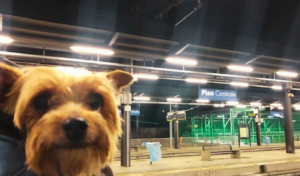 With numerous pet-friendly rail systems around the world, traveling with a pet by train is easier than ever. As most trains in Europe and North America tend to accommodate furry passengers, traveling by train can be a wonderful bonding experience for you and your pet. Taking your dog or cat on the train is not only less stressful but also cheaper than air travel. Additionally, trains are much safer for larger dogs who are forced to travel via cargo on planes. Find out the Top 10 Pet-Friendly Trains below:
#1 Cercanías (Spain)
On Spain’s national railway RENFE, pets travel for FREE on all Cercanías trains, the commuter rail system covering major urban areas in the country. As there are absolutely NO limitations on weight, pets (dogs, cats, and birds) do NOT need to travel in a crate or carrier as long as they’re on a lead. Tickets are also NOT required for your pet. Based on the official rules, dogs must travel with a muzzle. However, like many trains in Europe, enforcement may be hit or miss depending on the size of your dog. From what I’ve seen, non-muzzled dogs are generally the norm. With currently twelve Cercanías systems in Spain (Asturias, Bilbao, Cádiz, Catalonia, Madrid, Málaga, Murcia/Alicante, Santander, San Sebastián, Seville, Valencia, and Zaragoza), you and your pet will have a grand old time exploring Spain. Cercanías is linked to the Metro systems in Madrid, Barcelona, Bilbao, and Valencia – all of which are also pet-friendly. Like Metro, only one animal is permitted per passenger.
On all international routes on RENFE, pets can travel for only €15. The rule is that the animal may NOT exceed 10 kg and must be transported in a crate or carrier with dimensions not exceeding 60x35x35 cm. Sadly, this means larger dogs are not allowed on board. Like Cercanías and Metro, only one animal is permitted per passenger on international trains.
#2 Trenitalia (Italy)
Founded in 2000, Trenitalia operates regional trains, long-distance and high-speed trains, and international trains in Italy. Since Italy is one of the most dog-friendly countries ever, it only makes sense that their trains are particularly pet-friendly. Unlike the U.S. and Canada, small dogs, cats, and other animals can travel for FREE in both first and second class on all trains and in Executive, Business, Premium, and Standard service levels. They must travel inside a carrier not exceeding the dimensions of 70x30x50 cm. No size limit exists for large dogs as long as they are muzzled and leashed. They can travel on Espressi (Express), IC, ICN, Frecciabianca, Frecciarossa, and Frecciargento trains in both first and second class for a reduced ticket price at 50% of the original fare. However, large dogs are not permitted during rush hour time of 7-9 am Mondays thru Fridays. One dog is permitted per passenger. Also, their policy states that you must bring your dog’s E.U. Pet Passport or health documents or you may be fined or forced to get off at the next stop. Guide dogs for the blind always travel for free.
Despite the official rules, I’ve never seen a muzzled dog on the train throughout the several years of traveling and living in Italy. In addition, it’s not uncommon to see small dogs out of their carrier or on the laps of their humans – even as the train staff passes by. Of course, such dog passengers tend to be well-behaved and quiet. Furthermore, I’ve never been asked for my E.U. Pet Passport. Regardless, you should always follow the rules as a visitor. But if you somehow forget to muzzle your dog or bring your dog’s passport, chances are you should be OK.
#3 SNCB (Belgium)
The National Railway Company of Belgium, SNCB carries over 230 million passengers across 6,399 km of railway lines, including four high-speed lines. Taking your dog on a train in Belgium is easy peasy. Regardless of size, ALL pets are welcome on board for only €3 one-way. You can purchase the Pet Supplement ticket online. Like most European countries, small animals can travel for FREE as long as they can fit in a basket, cage, or travel box no larger than 30x55x30 cm. Although suggested on their website, muzzling your dog is not technically required. All dogs must be well-behaved and not disturb other passengers. Despite their policy stating that pets may not sit on the seats or tables, the enforcement can be hit or miss based on my observation. Of course, I would never recommend placing your pet on a table, but giving your pet a quick breather outside of the carrier is rarely frowned upon.
#4 Nederlandse Spoorwegen (Netherlands)
The busiest rail network in the E.U. (and the third busiest in the world after Switzerland and Japan), the national railway of the Netherlands a.k.a. Nederlandse Spoorwegen runs over 4,800 domestic trains and serves over 1.1 million passengers daily. Like most of Europe, small pets can travel for FREE on Nederlandse Spoorwegen as long as they’re in a bag, basket, or able to sit on your lap. For larger dogs, you must purchase a “dog ticket,” which only costs €3.30 and does not have to be checked in. You can easily reserve an e-ticket or mobile ticket for your dog online. Mandatory for larger dogs, this “dog ticket” is only valid in domestic NS and Arriva trains and must be combined with a passenger ticket. Your larger dog passenger must also be leashed. Regardless of size, animal passengers may not occupy a seat although small, well-behaved dogs may get a pass given that your fellow passengers don’t make a complaint. As usual, clearly recognizable guide dogs always travel for free.
#5 ÖBB (Austria)
Formally Österreichische Bundesbahnen-Holding, ÖBB is the national railway system in Austria. With a punctuality rate of 95%, this environmentally-friendly railway carries 287 million passengers annually, covering 4,859 km of track, 72% of which are electrified. With some of the most progressive animal protection laws in the world, Austria is known to be uber pet-friendly. Dogs and cats can travel for FREE on most lines here – given that they’re “small and harmless” and able to travel in carriers. However, if you take a pet that cannot be transported as hand luggage (in the case of larger dogs), then you must pay a fare for your pet. As fares vary based on the journey, you should get an estimate of your pet’s fare online before booking. Except for service dogs, all other dogs must be muzzled and on a leash. As expected, assistance dogs are exempt from the fare as well. Although dogs must technically sit on the floor, I’ve seen several well-behaved small dogs on the lap of their humans. And yet, the train staff and passengers seemed completely indifferent about it. Nonetheless, I would suggest gauging the environment onboard before testing out your luck. The only downside is their lack of flexibility as I’ve found in other European rail systems. Unfortunately, ÖBB only offers non-exchangeable and non-refundable tickets, which means you should finalize your travel plans before booking.
#6 SNCF (France)
SNCF stands for Société Nationale des Chemins de fer Français, which is France’s national railway consisting of 35,000 km of route with 14,000 daily trains and 2,600 km of high-speed lines. As most dog lovers know, France is a dog-friendly country where dogs can be found relaxing inside Parisian cafés alongside their humans. Hence, it’s no surprise that pets are allowed on SNCF’s TGV, Intercités, and TER trains. The limit is TWO animals per passenger, which is a refresher from the commonly found one pet per passenger policy. Pets are allowed on all trains in France except Eurostar, which is notorious for prohibiting pets onboard. Small domestic animals traveling in a closed bag or basket, muzzled dogs, and guide dogs for the blind are ALL welcome on board – well, provided that your fellow passengers do not object. The catch is that you do have to pay a ticket for your pet depending on the weight. If your pet weighs less than 6 kg and travels in a bag or basket no larger than 45X30X25 cm, then the fare is only €7. Your pet and carrier must also be placed on your knees or at your feet. However, tickets for small dogs inside a carrier are rarely checked. Regardless, I usually show my ticket to the train staff to be on the safe side. I’m not sure if there’s more of an honor system for small dogs or if it’s solely due to the fact that a carrier can pass as baggage.
For dogs or other animals larger than 6 kg, you must pay 50% of the original fare as calculated using the standard rate per kilometer. Per their policy, you must also muzzle them throughout the entire ride and keep them by your feet (although not always enforced). Guide dogs are always exempt from the muzzle and fare. You should also travel with your dog’s paperwork and health documents and ensure good behavior.
SNCF also has specific guidelines for a pet carrier that you must follow. For your pet’s sake, the carrier must be well-ventilated and provide enough space for your pet to turn around. The carrier should also be marked with your pet’s name, microchip ID #, your name, and contact information along with the address of your final destination. With that said, no one has ever asked to examine my carrier before or during a ride.
#7 National Rail (Great Britain)
Covering England, Scotland, and Wales, there are currently twenty-eight privately-owned train companies on Great Britain’s National Rail. Since passengers can take up to three items of personal luggage free of charge, traveling with your pet (dog, cat, or small animal) will incur an additional charge ONLY if you exceed the free allowance. Livestock (such as pigs, sheep, and goats) are prohibited on National Rail along with animals that cause inconvenience to other passengers due to their size or behavior, in such cases will be subject to removal. Provided that your dog or cat does not endanger or inconvenience the staff, they can travel for FREE unless, again, you exceed the luggage allowance. Two animals per passenger are allowed. If you’ve exceeded the luggage allowance, you must then pay 50% of the adult fare of the journey. Dogs must either be kept inside a carrier OR on a leash and harness. Animals traveling inside a carrier must be in an enclosed carrier that provides enough room for them to stand and lie down in comfort. You must also make a reservation in advance for your pet. If your pet occupies a seat, you could be charged extra. As the U.K. practices strict enforcement (as opposed to E.U. countries), I don’t recommend testing your luck here.
On sleeper trains (Caledonian Sleeper), dogs can accompany passengers for a heavy-duty cleaning charge. This charge does not apply to service animals.
#8 Hrvatske željeznice (Croatia)
Carrying over 20 million passengers annually, Croatian Railways or HŽ consists of 2,617 km of rails, 37.1% of which are electrified. Small dogs up to 30 cm can travel on trains for FREE as long as they’re inside a carrier or transport box OR be able to sit on their human’s lap.
As for dogs larger than 30 cm in height, they must be microchipped, leashed, muzzled, and travel with vaccination records/veterinary booklets. Although these required documents are hardly examined by the train staff, you should still carry them as a precaution. A discounted ticket at 50% must also be purchased at the cash register of the station for your large dog traveler. On a sleeper coach, you must specifically reserve and purchase a bed in the section for your dog. Yet, the sad irony is that dogs cannot touch the bed purchased for them. 🙁 Also, dogs are not allowed in dining coaches. Since you are also legally responsible for the cost of all damages incurred by your dog on the train in Croatia, you must ensure that your dog is well-behaved before considering travel. One dog is allowed per passenger.
Like always, E.U.-recognized service dogs are always allowed regardless of the size and do not need to be muzzled.
#9 Amtrak (U.S. & Canada)
Serving over 500 destinations in 46 states and three Canadian provinces, Amtrak is an extensive continental rail system in North America. With over 300 trains daily across 21,400 miles of track, Amtrak is a fun and safe way to travel cross-country with your pet. You can take your dog or cat onboard on most routes as long as the combined weight of the animal and carrier does not exceed 20 pounds. Pets are allowed on trips up to seven hours on most routes except for the following – Auto Train, Keystone Service, Pennsylvanian, San Joaquins, Capitol Corridor Pacific Surfliner, and Thruway Connecting Services.
Amtrak service is also available in three provinces in Canada (Québec, Ontario, and British Columbia), but pets are not allowed on the routes of Adirondack, Maple Leaf and Amtrak Cascades.
As the limit is five pets per train, it’s imperative to reserve online in advance. Also, bear in mind that the policy is one pet per passenger, and your pet must be at least 8 weeks old (and not to mention, odorless). Pet fees are $26 one-way/$52 round-trip (or 800 Amtrak Guest Rewards Points one-way).
For each travel segment, you’ll have to sign a waiver called the Pet Release and Indemnification Agreement. Essentially, you’re certifying that your pet hasn’t harmed anyone or shown aggression. In addition, your pet should be reasonably healthy and up-to-date with vaccinations. Furthermore, you hold Amtrak harmless of any claims or injury arising from your pet’s travel. Since this paperwork must be signed off by Amtrak personnel, you should arrive at the station at least 30 minutes before departure. And yes, they are keen on checking the paperwork onboard so do NOT skip this step. While walking to my gate, I was constantly reminded by different staff to have the form completed before boarding. The only exception is if you’re traveling with a service animal.
Whether soft or hard, your pet’s carrier must not exceed the following dimensions: 19x14x10.5 in. Again, the combined weight of your pet and carrier must not exceed 20 pounds. For your pet’s sake, he or she must be able to sit, lie down, and remain entirely inside without touching the sides of the carrier. Unfortunately, your pet’s carrier counts as one piece of carry-on baggage.
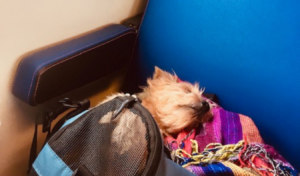
After riding Amtrak on both the East and West coasts, I am happy to report a generally positive experience. Despite a few occasional delays, the trains are usually on time and the entire process is organized. Except during commute hours, the trains are rarely full, which makes a less congested environment for your pet. With air-conditioning and filtration systems on all trains, your pet shouldn’t be struggling with heat or lack of ventilation inside the carrier. The seats are also clean and well-maintained. My only complaint is the relatively slow speed and seemingly excessive number of stops. Hence, if you’re used to high-speed trains in Europe, Amtrak can feel like a lackluster, expensive experience with a lot of squandered time.
#10 VIA Rail (Canada)
This Canadian rail service operates over 500 trains per week across eight (of ten) provinces covering over 7,800 miles of track. On the Quebec-Windsor Corridor, Via Rail allows small animals to travel as long as they are small enough to fit comfortably in a carrier that meets their maximum dimensions of 27x40x55 cm. The carrier must be leak-proof, well-ventilated, and spacious enough where your pet can stand up, turn around, and lie down comfortably. Although the policy indicates that your pet must remain inside the carrier near your feet at all times, I’ve gotten out for a couple of breathers without any issues. Again, it’s best to gauge the other passengers and environment beforehand.
Similar to Amtrak, a limit exists on the combined weight of the carrier and animal, capping at 10 kilograms/22 lbs. Unfortunately, the pet and carrier are considered an addition to the carry-on baggage allowance, which means an extra CAD 50.00 per direction. If an additional seat is required, then you must purchase an additional seat at the current rate based on availability at the time. In that case, you can place the carrier on the floor at the foot of the adjacent seat instead of in front of you. If you’re traveling business class, you can bring your pets along in the VIA Business Lounges as long as they remain inside the carrier and not left unattended. Don’t forget to book in advance for your pet’s travel.
Get more information on pet-friendly trains HERE.
Want more of Roger Wellington? Sniff Roger out here and follow his alpha paw prints on Instagram, Facebook, YouTube, & Twitter.


